Mastering Early Writing with Alphabet Tracing Worksheets
Providing structured tracing activities helps eliminate bad habits before they form. This specific worksheet packet ensures that children are practicing proper top-to-bottom and left-to-right stroke order while maintaining steady pencil control.
Visual Breakdown: What Is Included in These Alphabet Tracing Worksheets?
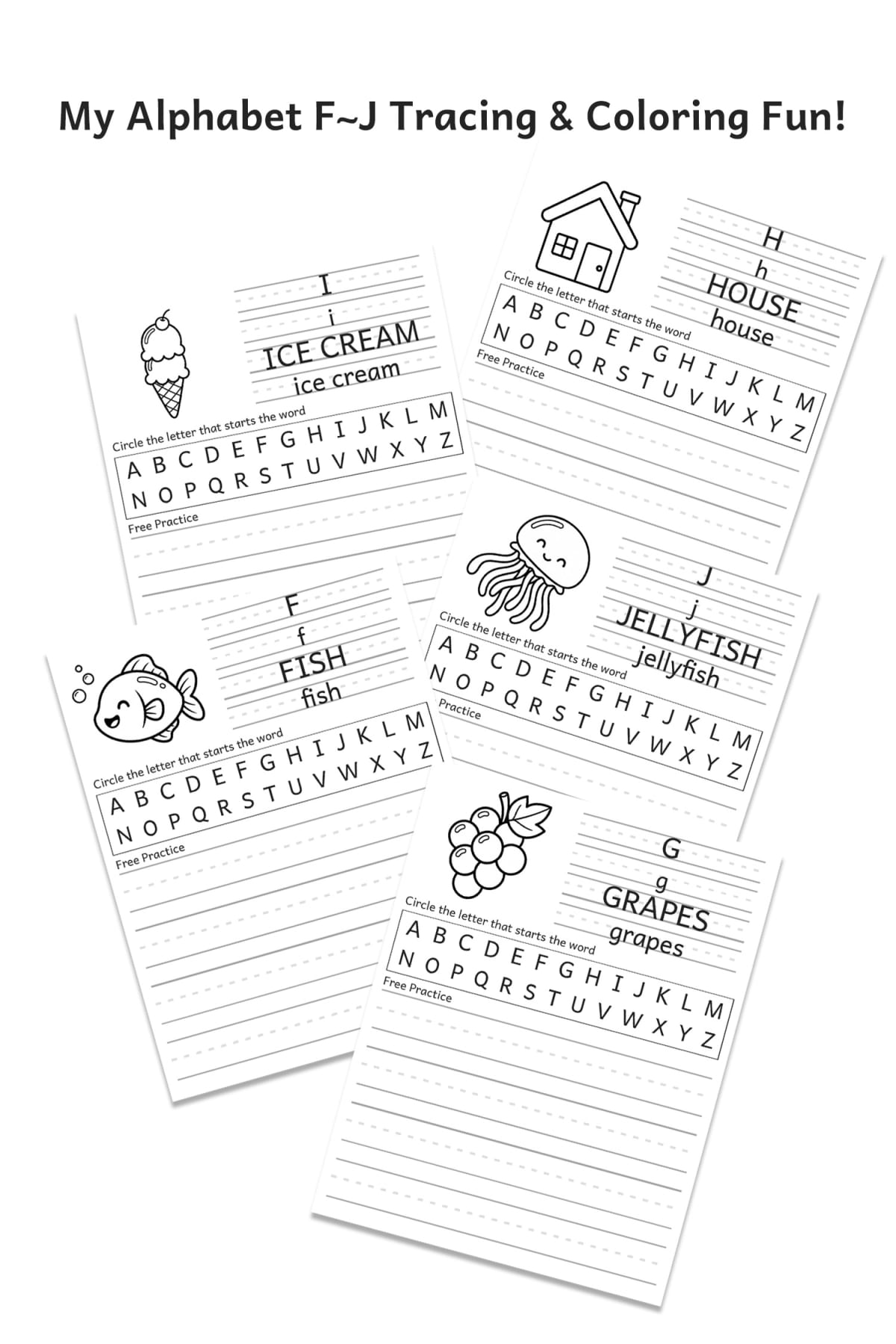
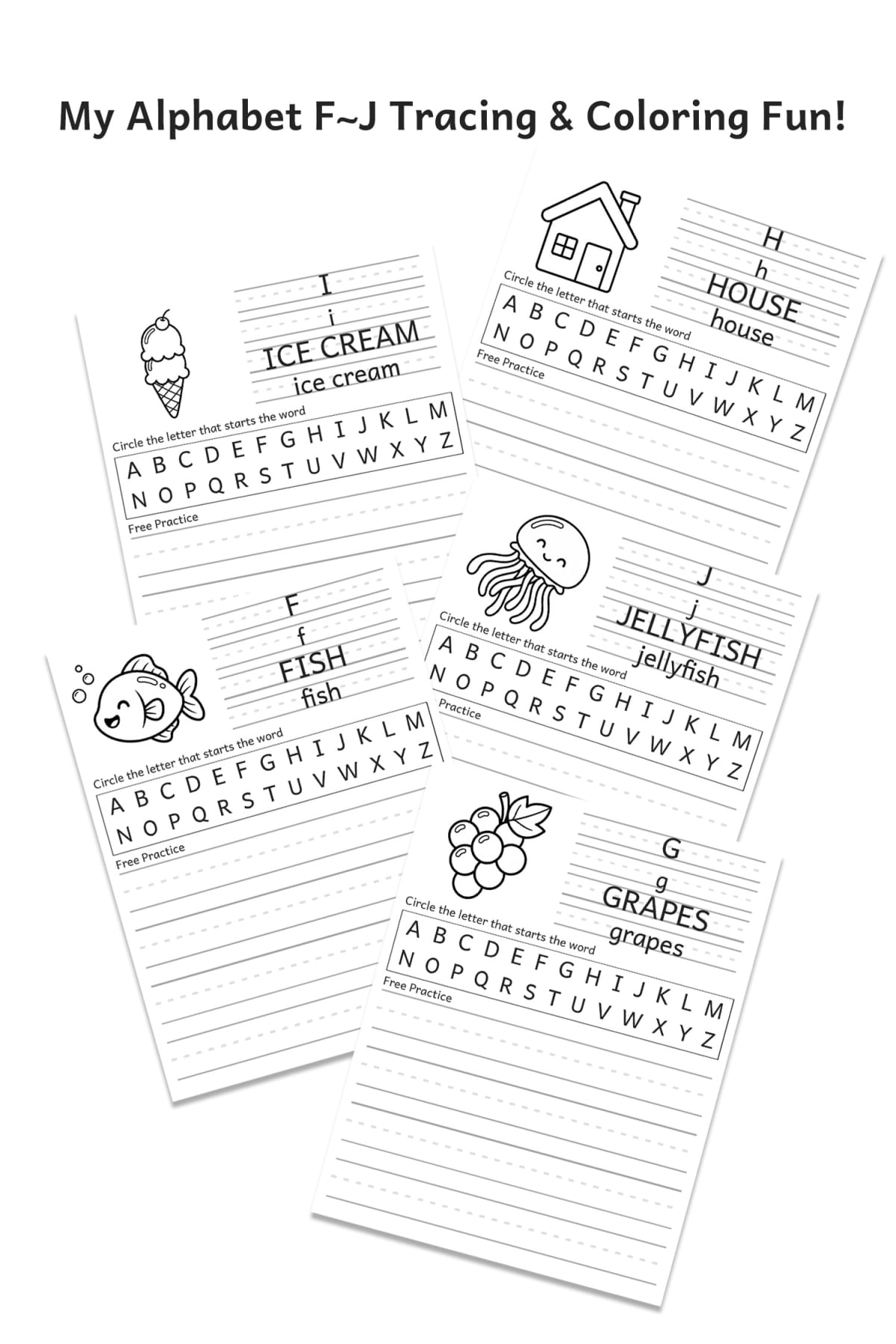
Each page in this five-sheet printable set follows a predictable, high-yield learning layout designed specifically for early childhood learners. Predictable layouts build confidence because children quickly learn what is expected of them on every page.
- Letter F Worksheet (Fish): Features a cheerful, easy-to-color fish icon. Children trace uppercase F, lowercase f, and the full word FISH in both uppercase and lowercase. Below the tracing lines, an A-Z alphabet grid challenges learners to find and circle the letter F. The bottom section offers empty dotted primary lines for free practice.
- Letter G Worksheet (Grapes): Highlights a detailed cluster of grapes with leaves. Students practice forming capital G and lowercase g, followed by tracing GRAPES and grapes. The alphabet selection grid reinforces visual discrimination between G and visually similar letters like C or O.
- Letter H Worksheet (House): Displays a charming house illustration. Children trace upper and lowercase H alongside the word HOUSE. The structured three-line handwriting guides help learners understand tall vertical strokes and middle horizontal crossbars.
- Letter I Worksheet (Ice Cream): Captures student interest with a stacked ice cream cone. Exercises focus on straight line strokes for uppercase I, lowercase i, and tracing the compound word ICE CREAM.
- Letter J Worksheet (Jellyfish): Features a cute jellyfish illustration with waving tentacles. Children practice the downward hook motion of uppercase J and lowercase j, along with tracing JELLYFISH.
Key Educational Benefits for Early Learners
Integrating targeted alphabet tracing worksheets into your daily routine supports multiple areas of early childhood development:
1. Fine Motor Strength and Pencil Control
Tracing dotted lines on primary handwriting lines helps young writers calibrate spatial awareness, hand-eye coordination, and grip strength. Moving from top-line to bottom-line with dotted center guides reinforces proper proportions and letter orientation.
2. Phonemic Awareness and Beginning Sound Recognition
Connecting the letter symbol with a clear anchor word (e.g., F for Fish, J for Jellyfish) solidifies initial sound recognition. The featured alphabet grid on each page encourages active scanning, requiring children to isolate the target letter from the entire alphabet sequence.
3. Dual Vocabulary Development (Uppercase and Lowercase)
Many early writing resources focus strictly on isolated letters. These pages go a step further by showing both uppercase and lowercase forms in isolated letters and whole context words (such as HOUSE and house). This prepares children for reading natural print in storybooks.
Creative Classroom and Home Activity Extensions
Worksheets work best when paired with hands-on, multi-sensory experiences. Here are practical ways teachers and parents can extend learning beyond the page:
Sensory Bin Object Match
Create a small sensory bin filled with dried rice or kinetic sand. Hide small toy objects representing each letter (a plastic fish, toy house, play grape cluster, ice cream scoop, or plastic jellyfish). Have children scoop out an item, identify its starting letter, and complete the matching worksheet.
Tactile Letter Building
Before tracing with a pencil, encourage children to form letters F through J using playdough ropes, Wikki Stix, or bent pipe cleaners. Physical construction builds muscle memory in fingers before fine motor pencil work begins.
Laminated Dry-Erase Literacy Centers
Slip these printed pages into reusable dry-erase sleeves. Provide colorful dry-erase markers and small sponges. Students can trace, erase, and practice multiple times throughout the week, making it a budget-friendly center activity for daycare and kindergarten classrooms.
Air Writing and Body Movement
Start your lesson with gross motor movement. Have children “air write” large letters F through J using their entire arm, starting at the sky and pulling down to the grass. Pair each movement with the corresponding phonic sound (e.g., “/f/ /f/ Fish!”).
Frequently Asked Questions
Why are three-line primary handwriting guides important for kindergarteners?
Primary lines feature a solid top line, a dotted middle line, and a solid bottom line. This structure gives children clear visual boundaries, helping them learn which letters are tall (like H and f), which stay below the middle line (like lowercase g’s loop), and which tail drop below the baseline (like lowercase j).
How can I support a child who struggles with pencil grip during tracing?
Offer shorter, thicker writing tools such as broken crayons, golf pencils, or triangular pencil grips. Shorter tools naturally force fingers into a tripod grip rather than a full fist grasp. You can also let them trace first using a index finger dipped in paint or on a tray of salt before moving to paper.
In what order should alphabet tracing worksheets be introduced?
While alphabetical order (A to Z) is common, many educators introduce letters by stroke complexity or phonics frequency (such as SATPIN). However, working through small clusters like F through J is ideal for weekly thematic units or focused handwriting practice once basic straight-line strokes are mastered.
Unlock Your Free PDF Printable
Enter your email below to get instant access to the worksheet.