Repetition builds muscle memory, which is exactly what small hands need for legible handwriting. By breaking the alphabet down into manageable chunks, these practice pages prevent cognitive overload and keep kids focused on just five letters at a time.
What is Included in These Alphabet Tracing Worksheets
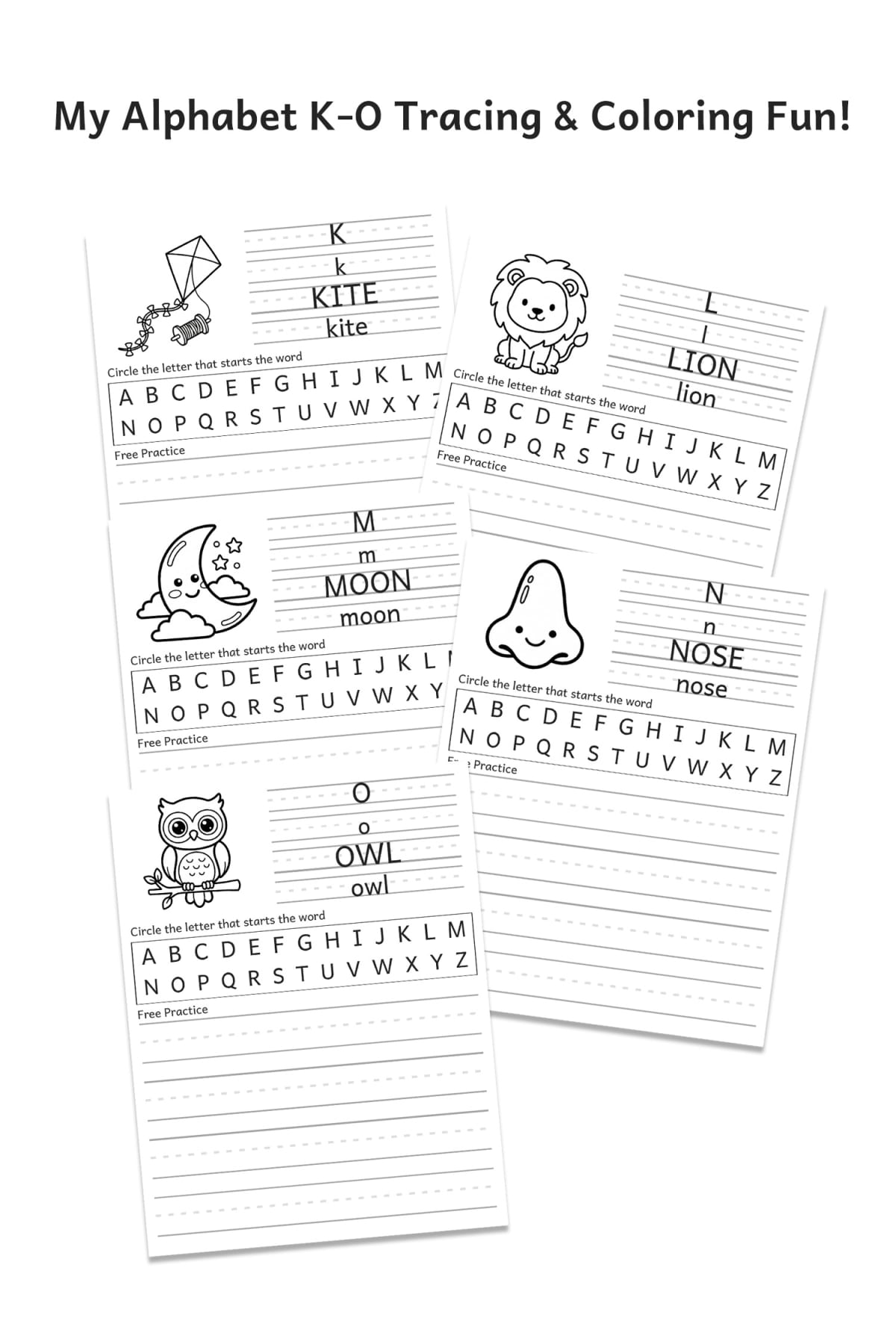
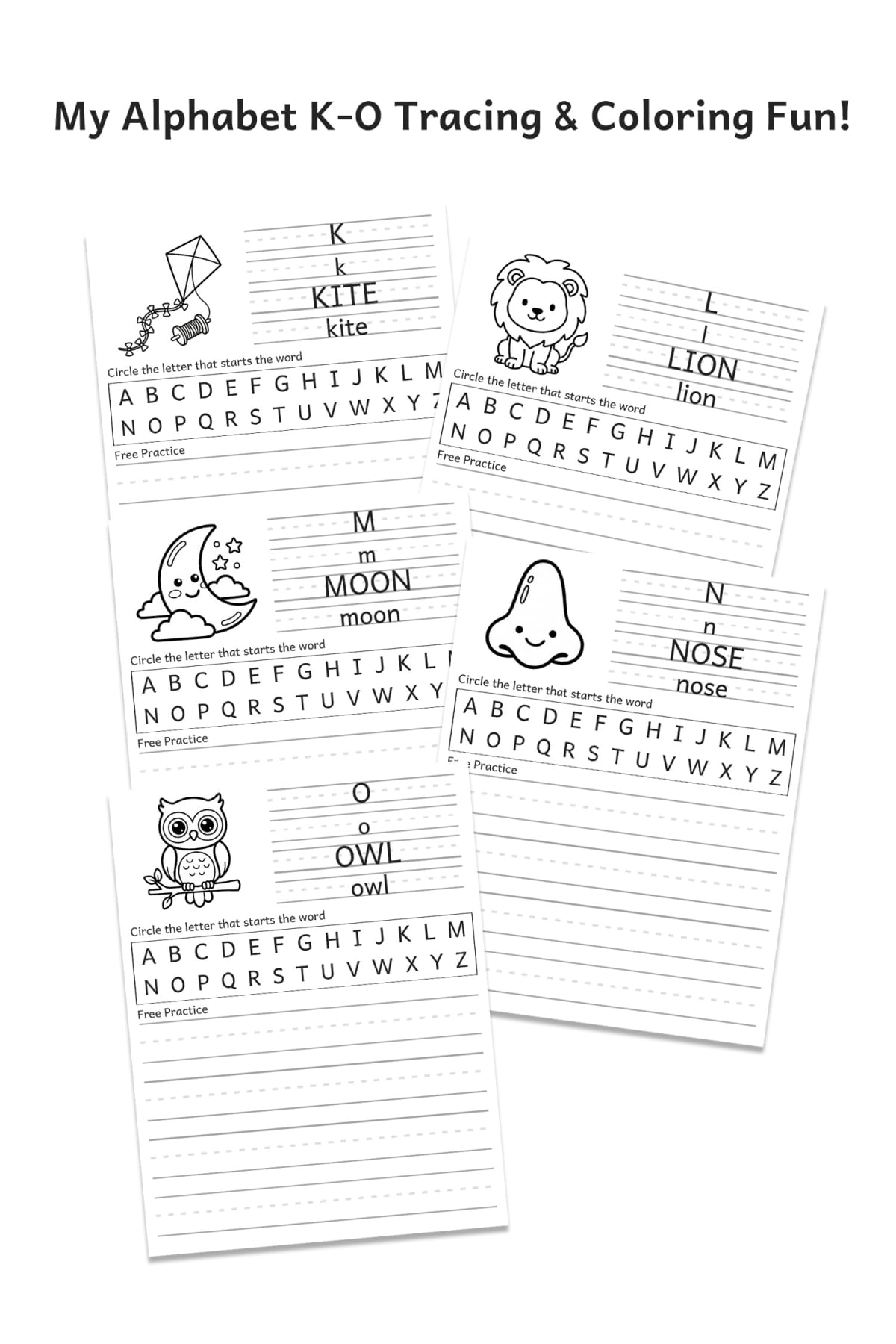
Each page in this 5-sheet printable set follows a predictable, structured layout that builds confidence in early writers. Predictability helps preschool and kindergarten students work independently without feeling overwhelmed by new rules on every page.
- Featured Image & Word Focus: Each letter page opens with an engaging, easy-to-color picture representing the target beginning sound:
- Letter K: A diamond-shaped kite with a flying string and ribbon tail, paired with uppercase K, lowercase k, and the word KITE / kite.
- Letter L: A friendly sitting lion, introducing uppercase L, lowercase l, and LION / lion.
- Letter M: A cheerful crescent moon surrounded by twinkling stars, focusing on M, m, and MOON / moon.
- Letter N: A cute nose character, guiding children through N, n, and NOSE / nose.
- Letter O: A wide-eyed little owl perched on a branch, highlighting O, o, and OWL / owl.
- Guided Line Tracing: Clear three-line writing guides (top line, middle dashed line, baseline) give young hands concrete spatial boundaries for tracing both uppercase and lowercase letters as well as the complete vocabulary words.
- Alphabet Identification Bar: A full horizontal letter strip from A to Z sits right in the middle of the worksheet. Children complete the directive prompt: “Circle the letter that starts the word.” This activity strengthens alphabetical order and visual discrimination skills.
- Free Practice Writing Space: The bottom half of every sheet features empty three-line ruling. Once learners trace the guided prompts above, they can independently attempt writing the target letters and words on their own.
Developmental Benefits of Alphabet Tracing Worksheets
Integrating structured alphabet tracing worksheets into your weekly routine offers benefits far beyond simple handwriting practice. Here is how these worksheets support critical early childhood milestones:
1. Fine Motor Strength and Pencil Grip Development
Tracing dotted lines forces small hand muscles to make precise, controlled movements. Staying within guided boundaries promotes a mature tripod grip and builds the finger endurance needed for primary grade writing tasks.
2. Spatial Awareness and Line Alignment
Understanding letter placement on lined paper can be tricky for young children. By working with top lines, center dashed lines, and baselines, children learn how tall letters (like ‘L’ or ‘k’) stretch upwards while short letters stay below the middle line.
3. Phonemic Awareness & Vocabulary Association
Connecting the letter visual with an intuitive picture—such as ‘O’ for ‘owl’ or ‘M’ for ‘moon’—reinforces initial consonant sounds. Colorable line drawings allow kids to spend extra time with the page, giving teachers and parents opportunities to talk about word meanings and sound blends.
4. Letter Scanning and Visual Discrimination
The middle strip prompt requires students to scan across a crowded row of letters and spot the target letter among distractor options. This mimics the visual tracking skills necessary for fluent reading from left to right.
Hands-On Activity Extensions for Classroom and Home
Worksheets work best when paired with tactile, multi-sensory experiences. Here are step-by-step ways to extend these letter pages for deeper classroom and home learning:
Sensory Letter Warm-Up
Before handing out pencils, let children trace the focus letter in a tray filled with salt, colored rice, or shaving cream. Have them practice starting from the top and drawing down, building muscle memory before attempting paper practice.
The Alphabet Search & Stamp Center
Laminate the printable worksheets or slip them into dry-erase pockets. Instead of circling the target letter on the A-Z bar with a pencil, give students playdough stamps or bingo daubers to mark the correct initial sound. Wipe clean for repeated center use.
Creative Free-Practice Prompts
Use the empty practice lines at the bottom of the page for creative extension prompts once tracing is completed:
- Have students draw their own picture starting with the target letter alongside the free-write space.
- Ask advanced kindergarteners to write a simple sentence incorporating the word (e.g., “I see the moon.”).
- Challenge students to trace in rainbow colors using three different colored pencils for extra fine motor repetitions.
Frequently Asked Questions
How can I adapt these sheets for children who struggle with pencil control?
Start by providing thicker writing tools like short triangle crayons or jumbo pencils, which naturally encourage proper hand position. You can also highlight the dotted tracing lines with a bright yellow highlighter so the tracing paths stand out clearly for visually overwhelmed learners.
At what age should children begin alphabet tracing?
Most children are ready for structured line tracing around ages 4 to 5 (late preschool or kindergarten entry). Prior to age 4, focus primarily on sensory tracing, finger painting, and gross motor mark-making to build essential muscle strength.
Why is free writing space included along with guided tracing lines?
Tracing helps children understand the correct stroke path, but writing independently builds actual memory recall and muscle mastery. Combining guided tracing and blank practice lines on the same page gives learners a safety net before taking the leap to independent letter formation.
Unlock Your Free PDF Printable
Enter your email below to get instant access to the worksheet.